
🟢 Supporting a Learner Driver · 8 min read
Supporting someone learning to drive isn’t about becoming their driving instructor. It’s about becoming the person who gives them the confidence to keep learning.
Not long ago, one of my learners told me something that made me smile.
Apparently, a grandparent had said:
“I only needed three driving lessons when I was your age.”
Maybe they really did.
Perhaps roads were quieter, traffic was lighter and expectations were different.
Or perhaps, like many family stories, time has quietly polished the memory.
Either way, it reminded me of something.
Supporting somebody learning to drive has probably never been easy.
It’s simply changed.
Today, many parents, grandparents, partners and friends find themselves sitting in the passenger seat wondering exactly the same thing:
“Am I helping… or am I making things worse?”
If that’s how you feel, you’re certainly not alone.
I’ve sat in both passenger seats
Most driving instructors only experience one side of learning to drive.
I’ve been fortunate enough to experience both.
Before I became a driving instructor, I helped my eldest daughter learn as simply her dad.
Several years later, I found myself helping my youngest daughter—but this time I was wearing two hats.
Dad.
And driving instructor.
It was fascinating.
I realised very quickly that those two roles aren’t quite the same.
One wants to teach.
The other simply wants to see someone they care about succeed.
Sometimes those two instincts work beautifully together.
Sometimes they don’t.
The kerb suddenly feels much closer
Here’s something I don’t think anyone warns you about.
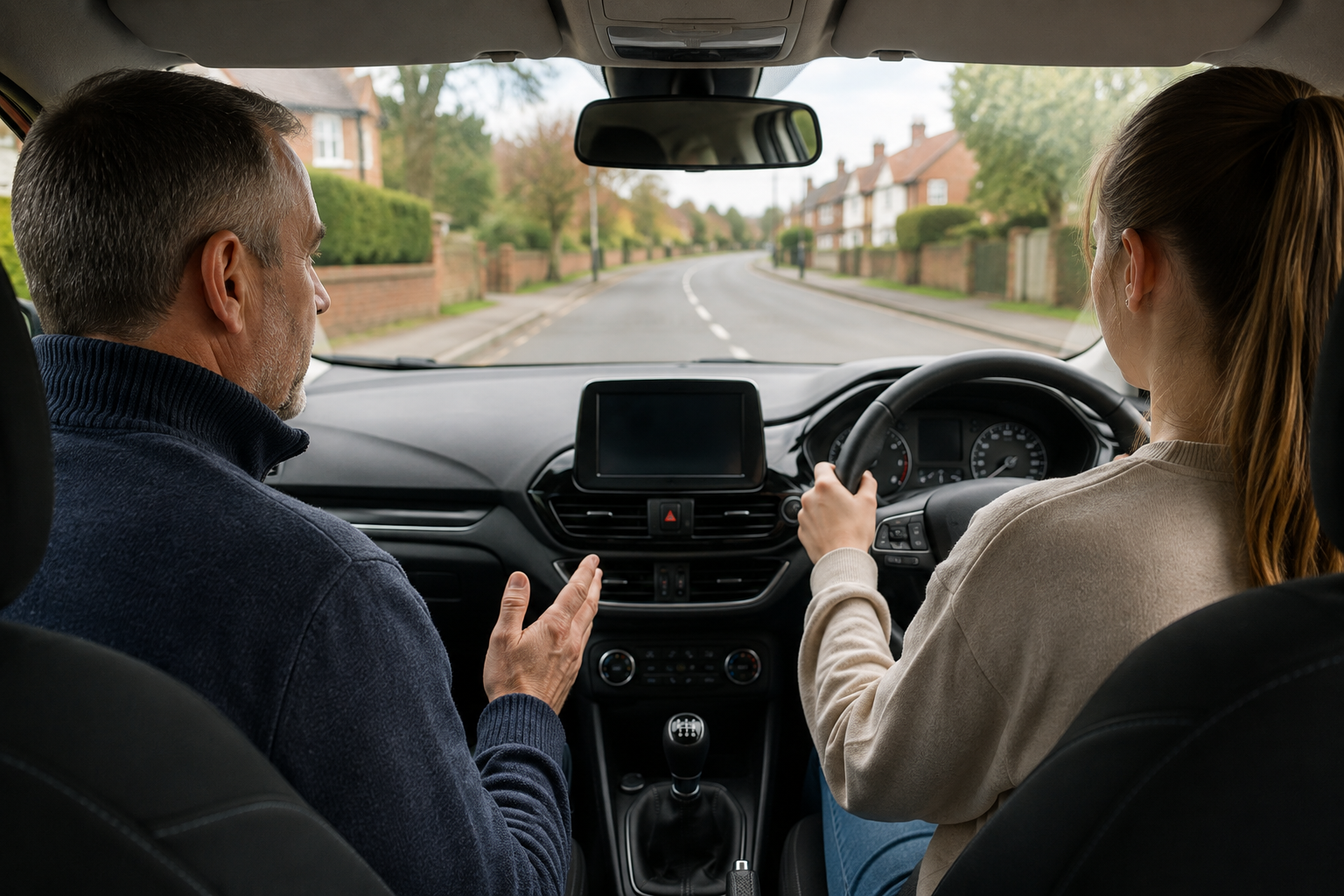
When you’re sitting in the front passenger seat supervising private practice…
the kerb suddenly looks incredibly close.
Much closer than it ever does from the driver’s seat.
You find yourself pressing an imaginary brake pedal.
You reach for a door handle that isn’t really helping anybody.
You tense up.
You probably say something.
Sometimes you say quite a lot.
I completely understand why.
Learning to drive can feel surprisingly stressful for the person doing the supervising as well.
One little thing I’ve suggested to several families is fitting one of those inexpensive round blind-spot mirrors to the lower corner of the left door mirror.
They’re only a few pounds.
They give the supervising driver a much better view of the kerbside.
Sometimes tiny changes make everybody feel just a little more relaxed.
You don’t need to become the instructor
This is probably the most important thing I’d like every parent or supporter to hear.
You are not expected to become a driving instructor.
Your learner already has one.
Your role is different.
In many ways, it’s even simpler.
Be encouraging.
Be patient.
Create opportunities to practise.
Help build confidence.
Allow mistakes to become learning opportunities rather than arguments.
The temptation is to fill every silence with advice.
To correct every small error.
To explain everything.
Ironically, that’s often when learning becomes harder.
Sometimes the greatest support we can offer isn’t another instruction.
It’s a little space.
Questions are often more powerful than answers
When I finish a driving lesson, I regularly ask my learners questions before I offer my own thoughts.
Questions like:
“How did that feel?”
“What do you think went well?”
“What might you do differently next time?”
Those questions encourage reflection.
They help people understand what happened instead of simply being told.
Parents and supporters can do exactly the same thing.
Instead of saying:
“You were far too close to that parked car.”
Try asking:
“How comfortable did that feel?”
Instead of:
“You should have slowed down earlier.”
Try:
“If you drove through there again, would you do anything differently?”
The conversation changes completely.
You’re no longer criticising.
You’re helping someone think.
That’s a very different experience.
Practise what they’re already learning
One of my favourite questions to ask a learner before they go out practising privately is:
“What did you do with your instructor in your last lesson?”
The answer usually tells us exactly where to start.
If they’ve spent the lesson working on roundabouts…
go and practise roundabouts.
If they’ve been learning hill starts…
find a suitable hill.
If they’ve been working on planning ahead…
simply drive somewhere familiar and focus on that one skill.
Private practice doesn’t have to be complicated.
It doesn’t need a brand-new lesson plan.
Sometimes it’s simply an opportunity to reinforce what they’ve already started learning professionally.
That consistency builds confidence.
Learning isn’t always measured in miles
One of the biggest misunderstandings about private practice is the belief that longer must automatically mean better.
It doesn’t.
A twenty-minute drive where everybody stays calm, talks afterwards and finishes feeling positive is often far more valuable than a two-hour marathon that ends in frustration.
Learning to drive isn’t an endurance event.
It’s a gradual process.
Progress often arrives quietly.
One smoother junction.
One better decision.
One little moment where something suddenly makes sense.
Those moments matter.
Celebrate them.
It’s alright to laugh
Driving lessons aren’t always serious.
Neither is private practice.
Some of my favourite memories involve laughing with learners after something unexpected has happened.
Nobody got hurt.
Nobody was put in danger.
Something simply didn’t quite go to plan.
Humour can be a wonderful teacher.
It helps people relax.
It reminds us that mistakes are normal.
It reduces tension.
Learning rarely improves when somebody feels embarrassed.
It often improves when they feel safe enough to smile and try again.
I still have to remind myself
Here’s an honest confession.
My daughters both drive now.
Occasionally, one of them drives me somewhere.
And every now and again…
I catch myself becoming a little too critical.
Not because I’m trying to be difficult.
Because driving is my profession.
I notice things.
Sometimes I have to stop myself.
And quietly remember something.
Today I’m Dad.
Not the driving instructor.
That little reminder changes everything.
I suspect many parents reading this will recognise themselves in that too.
Confidence grows between lessons
People often assume learning only happens during the official driving lesson.
I don’t think that’s true.
Some of the biggest improvements happen between lessons.
Not because somebody suddenly masters clutch control or perfect steering.
But because they become a little more comfortable.
A little less anxious.
A little more willing to have a go.
Confidence grows through encouragement.
Through repetition.
Through somebody quietly believing in you.
That’s something no driving instructor can provide on their own.
Families play a huge part in that journey.
Helping without taking over
Supporting somebody learning to drive isn’t about having all the answers.
It isn’t about teaching manoeuvres.
It isn’t about knowing every rule in the Highway Code.
And it certainly isn’t about becoming another driving instructor.
Sometimes the greatest gift you can give somebody is much simpler.
Your time.
Your patience.
Your encouragement.
Your willingness to sit beside them while they practise.
One calm conversation after a drive can be worth far more than twenty corrections during it.
Because long after the engine has been switched off…
long after the lesson has finished…
long after the test has been passed…
people rarely remember every instruction they were given.
They remember how the people around them made them feel.
If you can help somebody feel supported, encouraged and capable…
you’re already making an enormous contribution.
Not just to passing a driving test.
But to helping someone become a safe, thoughtful driver for life.
Wayne Smith
Founder, WS Driving Collective
Leave a Reply