
🟢 The Drive Home Matters Too
- Learning to drive has changed
- The conversation after the lesson
- You don't have to fix everything
- The drive home matters too
- And spare a thought for the person in the passenger seat
- I've sat in both seats
- Private practice should support the learning
- Try not to compare journeys
- A difficult drive isn't necessarily a bad drive
You don’t have to know how to teach someone to drive to make a real difference to how they learn
Yesterday, one of my learners told me something their grandparent had said:
“I only needed three lessons when I was your age.”
I’m sure it wasn’t intended to create pressure.
It was probably just a grandparent remembering their own experience of learning to drive many years ago.
But imagine hearing that when you’ve already had considerably more than three lessons and there are still things you’re finding difficult.
Suddenly, someone else’s memory has become a measure of your progress.
And that’s something worth thinking about.
Learning to drive has changed
I occasionally hear stories about people who had a handful of driving lessons, took their test and passed.
Some of them will be absolutely true.
But that doesn’t make them particularly useful as a comparison for someone learning today.
Roads have changed. Traffic has changed. Cars have changed. The driving test has changed.
More importantly, people are different.
One learner might pick something up quickly that another finds difficult. Give them something else to learn and the positions may be completely reversed.
Learning isn’t a race.
Yet it’s surprisingly easy for conversations at home to make it feel like one.
How many lessons have you had now?
When are you booking your test?
Your brother didn’t take this long.
I only needed three lessons.
Usually these comments come from people who care.
But good intentions and helpful outcomes aren’t always the same thing.
The conversation after the lesson
When someone gets home from a driving lesson, one of the first questions they’re likely to hear is:
“How did it go?”
There’s absolutely nothing wrong with asking that.
But we can perhaps do something more useful with the conversation that follows.
Instead of immediately asking whether they’ve mastered roundabouts or when their instructor thinks they’ll be ready for a test, try questions that allow them to think about their own learning.
How did that feel for you?
What do you think went well?
What could you have done differently?
What shall we do next time?
Those are very different questions.
They don’t require the parent, partner or supporter to know the answer.
In fact, that’s rather the point.
They encourage the learner to find some of the answers themselves.
You don’t have to fix everything
This can be difficult when it’s someone we care about.
If our children, partners or friends are struggling with something, our natural instinct is often to help.
We offer advice.
We tell them what we’d do.
We try to fix the problem.
Learning to drive can make that temptation particularly strong because many of us have been driving for years.
But being an experienced driver and knowing how to teach somebody else to drive aren’t quite the same thing.
Sometimes the most useful thing you can do is listen.
Let them explain what happened.
Ask what they think.
Give them a little space to work it through.
Support doesn’t always need to arrive disguised as advice.
The drive home matters too
You don’t need to become a driving instructor to support someone who’s learning to drive.
You don’t need to know the perfect technique for every junction.
And you certainly don’t need to have all the answers.
Your role can be much simpler.
Encourage them.
Listen.
Give them opportunities to practise where appropriate.
Celebrate progress.
Try not to compare their journey with somebody else’s.
And occasionally resist the temptation to fix everything.
Because some of the most valuable learning might happen after the engine has been switched off.
So the next time the learner in your life comes home from a driving lesson, perhaps don’t begin with:
“When’s your test?”
Try something different.
“How did that feel for you?”
Then give them the space to answer.
You might be surprised how much learning happens in the conversation that follows.
And spare a thought for the person in the passenger seat
There’s another side to private practice that I think instructors sometimes forget.
It can be pretty uncomfortable for the person sitting beside the learner too.
If you’ve driven for years, you’re accustomed to sitting on the right-hand side of the car.
Suddenly you’re sitting in the front left seat.
You haven’t got a steering wheel.
You probably haven’t got dual controls.
And that kerb can look very close indeed from over there.
Add the fact that the person driving is someone you care deeply about and it’s hardly surprising that parents and supporters sometimes become anxious.
That anxiety can come out as:
Slow down.
Watch the kerb!
Brake!
What are you doing?
Which probably doesn’t do much for the learner’s confidence either.
Recognising what’s happening can help both of you.
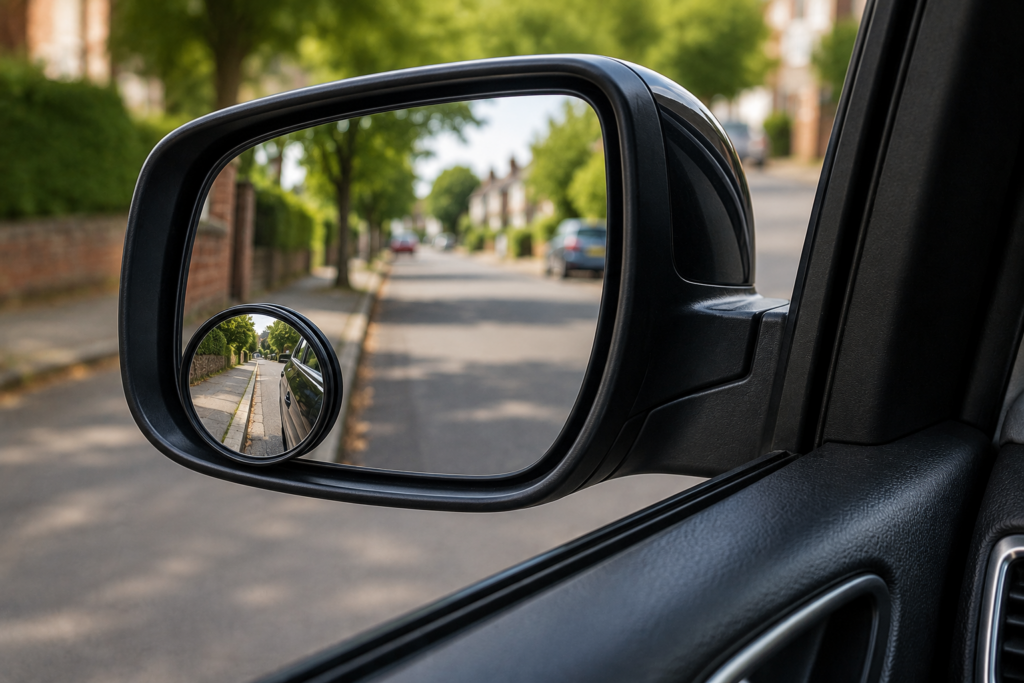
Even something as simple as an additional blind-spot mirror fitted to the left door mirror can give the supervising driver a better view and help them feel a little more aware of what’s happening around the car.
Small things can make private practice feel less stressful.
I’ve sat in both seats
I’ve had an interesting perspective on this myself.
When my eldest daughter was learning to drive, I was primarily experiencing it as Dad.
By the time my youngest daughter was learning, I was both Dad and a driving instructor.
You might imagine that professional experience made everything straightforward.
I’m not convinced it did.
Being someone’s parent changes the relationship.
When you’re teaching a learner professionally, there’s an emotional distance that simply isn’t there when it’s your own daughter sitting behind the wheel.
You care.
You want them to be safe.
And sometimes that makes it harder to sit quietly and let something develop.
Even now, when my daughters drive me around, I know I can sometimes be too critical.
I try to explain that driving is my profession and that I care deeply.
Both things are true.
But I’m also aware that having professional knowledge doesn’t automatically mean every observation needs to be shared.
Sometimes Dad probably just needs to enjoy being the passenger.
I’m still learning that one.
Private practice should support the learning
One of the best examples I’ve heard from a supporter was wonderfully simple.
They asked the learner:
“What did you do in your last lesson with your instructor?”
And then:
“Shall we go and practise some more of that?”
That’s excellent.
They weren’t trying to become the instructor.
They weren’t introducing their own method.
They weren’t saying:
“Forget what your instructor told you — this is how I’ve always done it.”
They were helping the learner get more experience with something they were already working on.
That’s the difference between supporting the learning and taking over the teaching.
Private practice can be enormously valuable.
It gives learners experience of different roads, different situations and simply more time making decisions.
But it doesn’t need to become another formal driving lesson.
Try not to compare journeys
Perhaps one of the most valuable things a supporter can do is remove some of the pressure around progress.
There isn’t a correct number of hours in which somebody should learn to drive.
There isn’t an age at which somebody should find it easy.
And somebody else’s driving test result tells us very little about the person learning today.
Progress isn’t always obvious either.
A learner may have a lesson where very little new is introduced, but they begin making decisions with less help.
They may encounter a difficult situation and deal with it better than they would have a month earlier.
They may make a mistake — and recognise it themselves.
Those are all signs of learning.
Not everything worth celebrating ends with:
“I passed.”
A difficult drive isn’t necessarily a bad drive
Private practice won’t always go smoothly.
Neither will professional driving lessons.
There will be wrong turns, stalls, awkward junctions, missed opportunities and occasions when everybody in the car would benefit from a few quiet minutes.
That’s okay.
A mistake isn’t automatically evidence that someone isn’t progressing.
Often the interesting question comes afterwards:
What did we learn from that?
If something has become tense, it may be better to stop rather than trying to rescue the drive.
There will be another opportunity.
Learning tends to work better when everybody feels able to think.