
We’ve Been Here Before: Making AI Useful, One Small Step at a Time
AI can do some extraordinary things. But perhaps the best place to start isn’t with what AI can do. It’s with something you’d like to make easier.
When I was growing up, if you wanted to telephone somebody, you used the landline at home.
If you were out, you found a telephone box.
And we managed perfectly well.
I think I was in my thirties when I got my first mobile phone. At the time, the amazing thing was simply that you could make a telephone call without being attached to the wall.
Now look at the thing in your pocket.
It takes photographs, manages your diary, does your banking, plays your music, sends messages around the world, tells you where you’re going and gives you access to more information than we could possibly have imagined back then.
Occasionally, you can even use it to telephone somebody.
Technology has a habit of doing that.
Something that initially seems unfamiliar gradually becomes useful and, eventually, completely ordinary.
I wonder whether we’re somewhere near the beginning of that journey with AI.
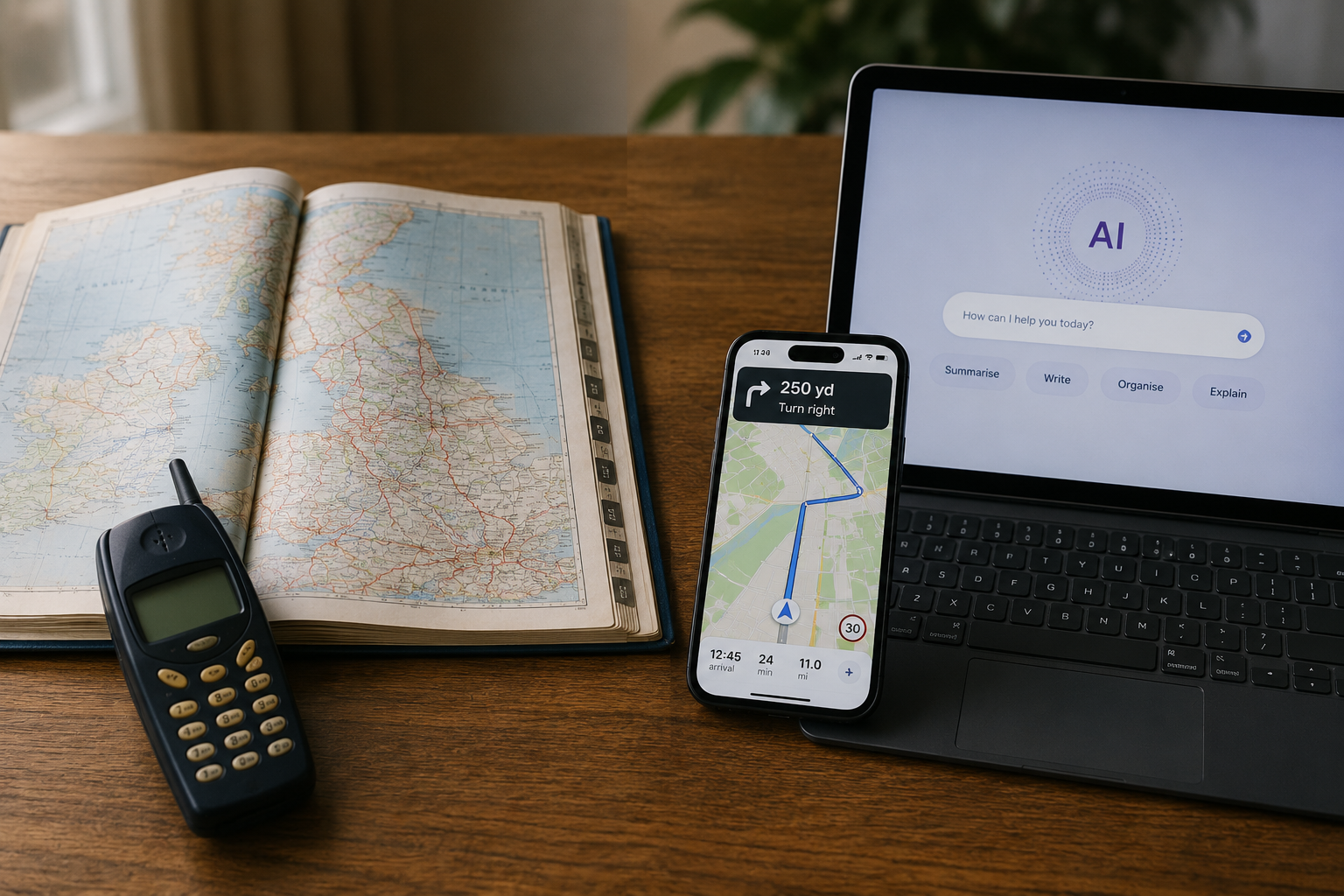
From Road Atlases to Sat Navs
Driving instructors of a certain age will probably remember another transformation particularly well.
The road atlas.
There was absolutely nothing wrong with it. It got us around Britain for decades.
Then along came dedicated sat navs such as TomTom.
Suddenly, instead of finding the right page, working out where you were and planning every turn yourself, you could enter a destination and the technology helped you get there.
Miss a turning?
It recalculated.
Then smartphones gradually absorbed that job too.
Today, most of us don’t marvel at the technology involved. We simply want to get somewhere and expect our phone to help us find the way.
And that’s an important distinction.
We didn’t really want sat navs. We wanted an easier way to get somewhere.
I think exactly the same principle should apply to AI.
Start With the Problem, Not the Technology
I’ve always been interested in technology.
I’ve probably been an early adopter for most of my life. I love gadgets and remember showing a younger friend financial software that allowed me to keep track of my financial position in real time, long before banking apps made that sort of thing completely normal.
But being interested in technology doesn’t mean I think we should use it simply because it exists.
I’ve owned a Ring doorbell.
Enough said.
Sometimes technology simplifies our lives.
Sometimes it finds remarkably inventive ways of making them more complicated.
So when I think about AI, my starting question isn’t:
What can AI do?
It’s:
What problem am I trying to solve?
How It Started for Me
My original attraction to AI was actually very simple.
I have lots of thoughts.
Getting those thoughts out of my head and into a well-structured piece of writing has traditionally been rather more difficult.
AI helped me bridge that gap.
The ideas were still mine. The experiences were mine. The opinions were mine.
But suddenly I had a tool that could help me organise them and communicate them more clearly.
That was useful.
So I kept exploring.
Not because I had developed an “AI strategy”, but because I started noticing other problems it might help me solve.
The Benefit Matters More Than the Feature
Today, I use AI in quite a few areas of my driving school and in developing the WS Driving Collective.
It helps with this Journal, website development, SEO and improving my Google Business Profile.
But simply listing those things misses the point.
The interesting part is what I get back.
Sometimes that’s time.
Sometimes it’s clarity.
Sometimes it’s headspace.
Sometimes it’s access to knowledge or skills I don’t personally have.
And sometimes it allows me to respond better to an individual learner.
Recently, for example, I was teaching an American student who was finding some of the differences between American and British driving terminology confusing.
I could have simply explained each difference as we encountered it.
Instead, I used AI to help create an American-to-British guide to driving terminology specifically for that learner.
The clever bit wasn’t that AI could produce a list of words.
The benefit was that I could respond quickly to a particular learner’s need and give them something useful to take away.
That’s a very different way of looking at technology.
Giving Myself Some Headspace
Another example happens at the end of a driving lesson.
That’s the point when the lesson is freshest in my mind.
Rather than relying on myself to remember everything later, I can capture my thoughts while they’re still there and use AI to help organise them into useful lesson notes.
Again, the feature isn’t particularly interesting.
The benefit is.
I have a better record.
I don’t need to reconstruct the lesson hours later.
And perhaps most importantly, I don’t need to keep carrying all that information around in my head.
It’s done.
That creates a little more headspace for whatever comes next.
But My System Already Works
I understand why some driving instructors look at AI and wonder what all the fuss is about.
Some instructors still use pen and paper to keep their records.
And the obvious response is:
“It’s worked perfectly well for me until now. Why should I change?”
That’s a fair question.
Perhaps you shouldn’t.
If your current system works well, gives you everything you need and isn’t creating unnecessary work, I’m certainly not going to tell you to change it simply because something newer exists.
We managed with road atlases too.
The question is whether something else could make part of the process better.
Not newer.
Better.
Keep It Simple
I recently attended an AI conference for driving instructors.
One thing struck me.
There were instructors in the room who had already taken the fairly significant step of attending a conference specifically about AI.
They were interested.
They wanted to learn.
Yet I felt some of what was being presented simply wasn’t landing with much of the audience.
It wasn’t because people weren’t capable of understanding it.
I think we were sometimes starting too far along the journey.
AI can quickly become a conversation about prompts, automation, agents, integrations and terminology that means very little to someone wondering what ChatGPT could actually do for them on Monday morning.
That’s where an old principle comes in rather handy:
KISS — Keep It Simple, Stupid.
We don’t need to demonstrate how complicated AI can be.
We need to make it useful.
One Small Step
If an instructor said to me:
“Everyone keeps talking about AI. I feel like I’m falling behind, but I haven’t got a clue where to start.”
I wouldn’t suggest a course.
I wouldn’t give them twenty AI tools to investigate.
And I certainly wouldn’t tell them they need to transform their business.
I’d say:
Choose one problem.
Something you find annoying.
Something repetitive.
Something that takes longer than you think it should.
An email you struggle to word.
Some notes that need organising.
An explanation one of your learners isn’t quite understanding.
Then see whether AI can help with that one thing.
If it helps, keep using it.
If it doesn’t, don’t.
Then, when you’re ready, perhaps try something else.
Don’t Hand Over the Steering Wheel
There’s another lesson we can borrow from sat navs.
A sat nav can suggest a route.
It doesn’t remove our responsibility for deciding whether that route is safe or sensible.
AI should be treated in much the same way.
It can help us think, organise, research, explain and create.
It can also be wrong.
There are legitimate questions around privacy, accuracy, over-reliance and how our information is used. We shouldn’t dismiss those concerns simply because we’re excited about the technology.
And there are places where I personally don’t want technology getting in the way.
A face-to-face conversation with another human being is one of them.
Technology should support relationships.
It shouldn’t automatically replace them.
Perhaps We’ve Been Here Before
I have no idea exactly where AI will eventually take us.
None of us does.
But I do recognise something about this moment.
I’ve seen technologies arrive before that initially seemed unfamiliar, unnecessary or complicated.
Then somebody found a useful application.
Then another.
And gradually we stopped thinking about the technology and started appreciating the benefit.
The telephone box didn’t disappear because somebody gave us a lecture about telecommunications.
The road atlas didn’t largely disappear from our cars because somebody explained GPS satellites.
Something came along that made particular jobs easier.
AI needs to earn its place in exactly the same way.
So if you’re curious about AI but don’t know where to begin, I wouldn’t begin by trying to understand AI.
Begin with your own working day.
Find one problem.
Try one thing.
Decide whether it helped.
Then perhaps take another small step.
Because I don’t think driving instructors need an AI strategy before they get started.
We need problems worth solving.
And technology that genuinely helps us solve them.
Wayne Smith
Founder, WS Driving Collective
Leave a Reply